Ozon · Mobile App · E-commerce
Ideal flow of
purchases
Ideal flow of
purchases
Ozon - is one of the largest marketplaces in Russia, you can buy there almost everything, it is already possible to buy even a car!
The task was to create a purchasing path on Ozon with the fewest steps, not only through the Ozon Card, but overall: how to reduce flow in various purchasing scenarios.
7
Hypotheses
6
Work stages
4
Interviews conducted
Test
with users
7
Hypotheses
6
Work stages
4
Interviews conducted
Test
With users
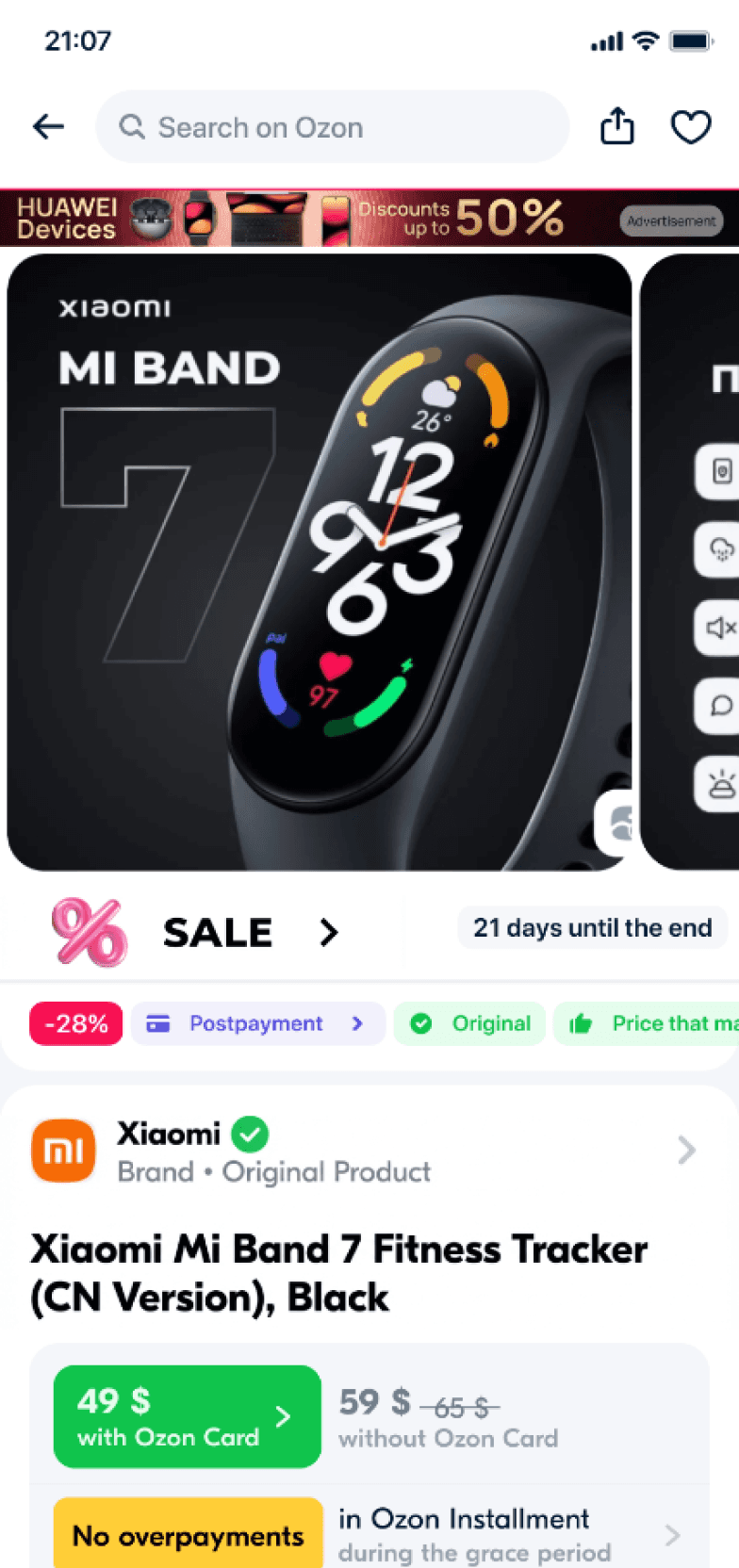
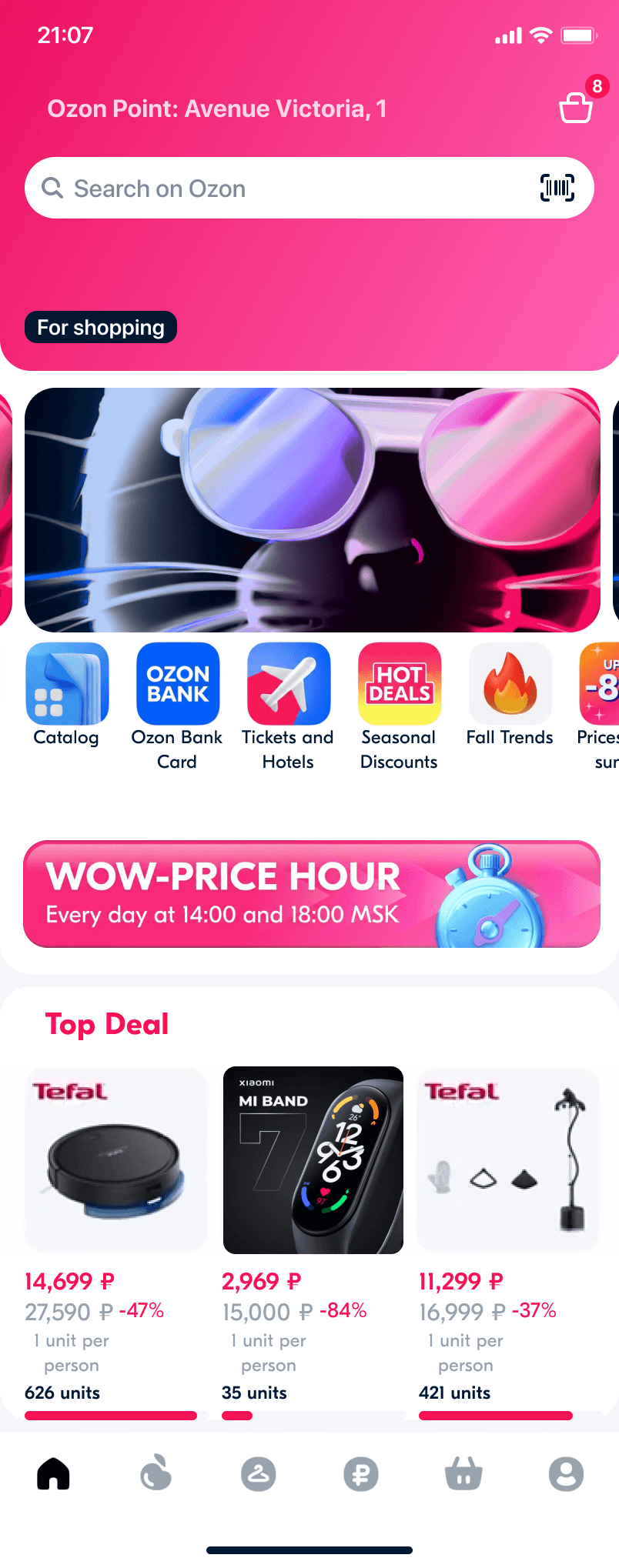
Task
Minimum clicks to purchase
To create the "ideal flow" for making a purchase on Ozon with the least number of steps. The task was considered not only through payment with the Ozon Card but more broadly: how to optimize the customer's journey across different product categories.
The key challenge is to find a balance between the speed of checkout and user awareness, without sacrificing business metrics (average order value, conversion rate, advertising revenue).
Problems
Difficulties before the payment process
01
Unnecessary steps in the purchasing process
Especially noticeable when paying by card and receiving discounts and bonuses: the user goes through too many intermediate screens
From user's feedback
02
Inconvenient navigation interface
"Very inconvenient interface, too many unnecessary clicks. For example, to pay by card, you have to go through a lot of steps"
From user interview
Process
Stages from brief to test
01
Research
Brief, brand study, competitive analysis, current user journey
02
Hypotheses
Idea generation, 5 hypotheses to check with users (+additional during interview)
03
Interviews
User interviews for hypotheses validation
04
User Flow
User flow, based on data and revisions
05
Prototype and Design
Creating design solution
06
Test
Test with users to check proposed solution
Competitive analysis
Detailed analysis of 3 marketplaces
Detailed analysis of
3 marketplaces
I thoroughly made research of the user flow, I took three competitors: Yandex.Market, Wildberries, and Temu. For each of them I created a complete task flow, documented all screens from search to payment, and analyzed strengths and weaknesses.
Wildberries
Fast purchase flow, but overloaded product cards and complicated category navigation
Yandex.Market
Clear interface, but a long path to payment; interesting solutions in filtering
Temu
Aggressive upselling, but an effective recommendation system after payment and quick one-click purchase
During competitive analysis I found some interesting scenario and details, which could be used also in Ozon to improve it.
Current flow
How the purchase process works now
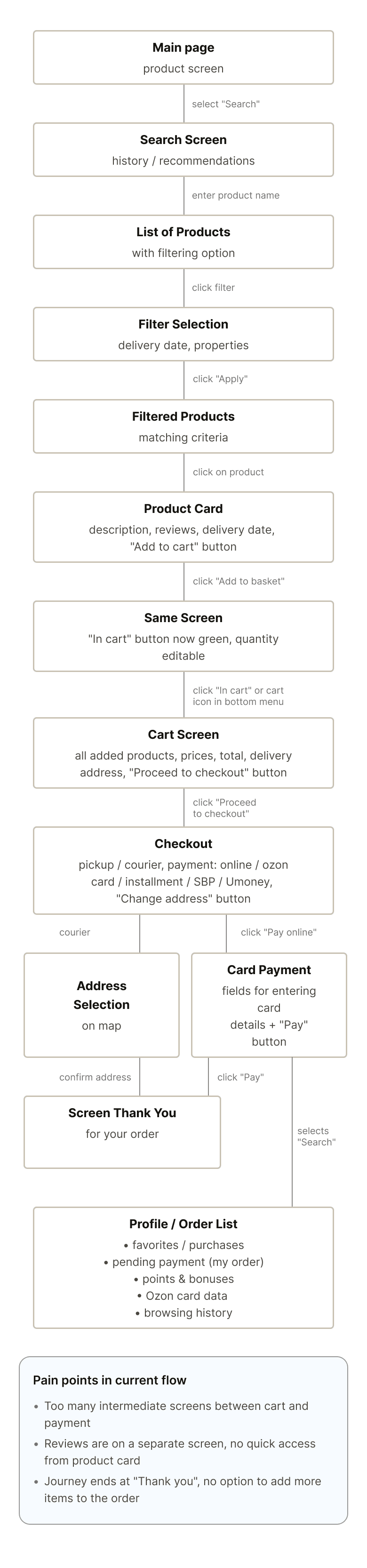
I documented the complete task flow in the Ozon app from the main screen to payment confirmation.
I identified pain points: unnecessary steps between the cart and payment, lack of quick access to reviews, and a dead end on the "Thank you for your order" screen

research summary
What the research showed
Collecting all data from competitor analysis, competitor flows and points-to-improve from current Ozon flow, I summarized all the information and continued to work with following points
Product Card
Adding to favorites and product overview: A conveniently placed button for adding to favorites will help users plan their purchases more quickly. It is important that the product description remains free of distracting blocks (e.g., ads or recommendations)
Detailed product description
Users highly appreciated when the product description and photos are not interrupted by unrelated blocks. For Ozon, this means that ads and recommendations can be placed lower to avoid distracting from the main product details. This point is in question, as ads is an additional source of revenue, which is a business goal
Product Variation Selection
Allowing users to select multiple colors or options for a product enhances the shopping experience
Returning to Previous Steps
Allowing users to edit their cart after entering payment information simplifies the ordering process
One-Time Payment Option
Offering one-time payments without saving card details enhances security and builds user trust
Quick Recommendations and One-Click Purchase
After checkout, a screen with quick recommendations allows users to add items with one click, catering to those who remember needed items exact after purchase
Payment System for users in age 45+
The payment interface should be intuitive, considering that some users may lack mobile banking. Simplifying payment processes will benefit those unfamiliar with technology
Cluttered Interface
UI optimization: A cluttered interface is difficult to master, especially for new users and older audiences. Simplifying and minimizing visual noise will help users find the necessary functions and sections more quickly
Displaying Reviews
It is convenient when reviews can be quickly viewed without navigating to other pages. This saves time and allows for a quicker assessment of product quality
Hypotheses
5 hypotheses for interviews
I thoroughly researched the user flow of three competitors: Yandex.Market, Wildberries, and Temu. For each of them, I created a complete task flow, documented all screens from search to payment and analyzed strengths and weaknesses
01
The importance of quick review access
Hypothesis: If we enable quick viewing of reviews directly on the product card (without navigating to a separate page), the number of clicks on reviews will decrease by 15%, and the speed of adding items to the cart will increase by 10%.
Metric for verification: Number of clicks on reviews; average time spent on the product card; percentage of users who read the reviews.
Approved
02
Notifications about availability
Hypothesis: If we add notifications about item availability at the cart addition stage, the abandonment rate at the checkout stage will decrease by 20%.
Metric for verification: Abandonment rate at the order completion stage; number of clicks to the product page from the cart.
Failed
03
Adding items after checkout
Hypothesis: If we add a section with recommendations and the ability to add items to the order after it has been placed, the average order value will increase by 10%.
Metric for verification: Average order value; conversion rate of the additional recommendations section; frequency of adding items from the section after purchase.
Partly confirmed
04
Demonstrating the benefits of the Ozon Card
Hypothesis: If we show the expected benefits that the user will receive when paying with the Ozon Card directly on the product page, this will increase the share of orders paid with the Ozon Card.
Metric for verification: 1) percentage of users who click for more details or to activate the Ozon Card.
2) Share of orders paid with the Ozon Card - tracking the percentage change in the number of orders paid using the Ozon Card.
Need more data
05
Direct payment via Fast Payment (FP)
Hypothesis: If we provide the option for direct payment via FP without an intermediate screen for bank selection (for example, through automatic QR code generation that can be scanned with any banking app), this will simplify the process and increase the number of successful transactions.
Metric for verification: Conversion to completed orders with payment via FP, the percentage of orders completed using FP, before and after implementing the simplified method without bank selection.
Frequency of errors and cancellations at the payment stage via FP - the number `of failed transactions (errors, interruptions) when paying via FP before and after simplifying the interface.
Partly confirmed
interviews
Preparation & insights

During the interviews I checked hypothesis and also found interesting insights
Filtering reviews by keywords
Users want to quickly find relevant reviews instead of scrolling through everything
The Ozon card is more of a savings tool
Rather than a full-fledged banking product, perceived at the level of discounts and cashback
Order to the wrong address
A common problem that leads to order cancellation and reordering
QR code as an alternative to card linking
Preferred by those users who value security and avoid linking cards
QR code as an alternative to card linking
Preferred by those users who value security and avoid linking cards
Additional hypotheses
Hypotheses from insights
Based on insights from interviews, I added 2 additional hypotheses for further testing and took three (№3, №1 and №5) which was also approved as pain point.
Hypothesis 6
Quick scrolling of top reviews directly on the product card, as well as filtering by keywords and sorting by "usefulness"
Additional
Hypothesis 7
Fixing important product's option will help to find needed data of the item and make decision quickly
Additional
Hypothesis 1
Quick viewing of reviews directly on the product card will decrease the number of clicks on reviews
Adding products after payment —> "Pay in 1 click" screen within 10 minutes +personalized recommendations
Hypothesis 3
Adding products after payment —>
"Pay in 1 click" screen within 10 minutes +personalized recommendations
Hypothesis 5
Direct payment via FP with QR code, without an intermediate bank selection screen
New flow
New f low based on data
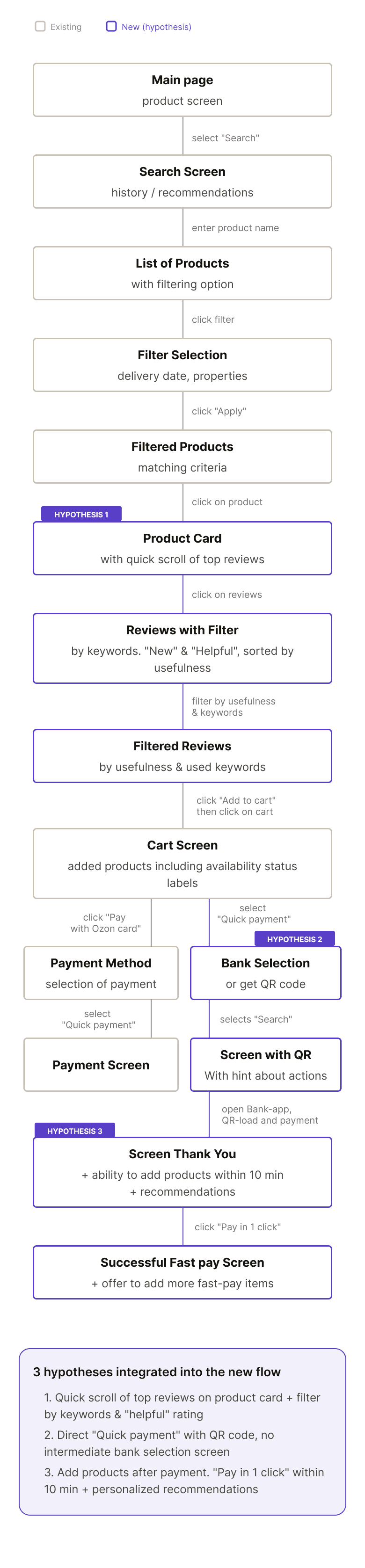
Based on interviews and research, I created a user journey. 3 hypotheses were added to this flow for further testing. 8 screens prepared for minimal testing and hypothesis validation with real users

Solution
Quick view of the new user flow
Hypohesis 1, 6 and 7. I adopted the process according to how users work with reviews:
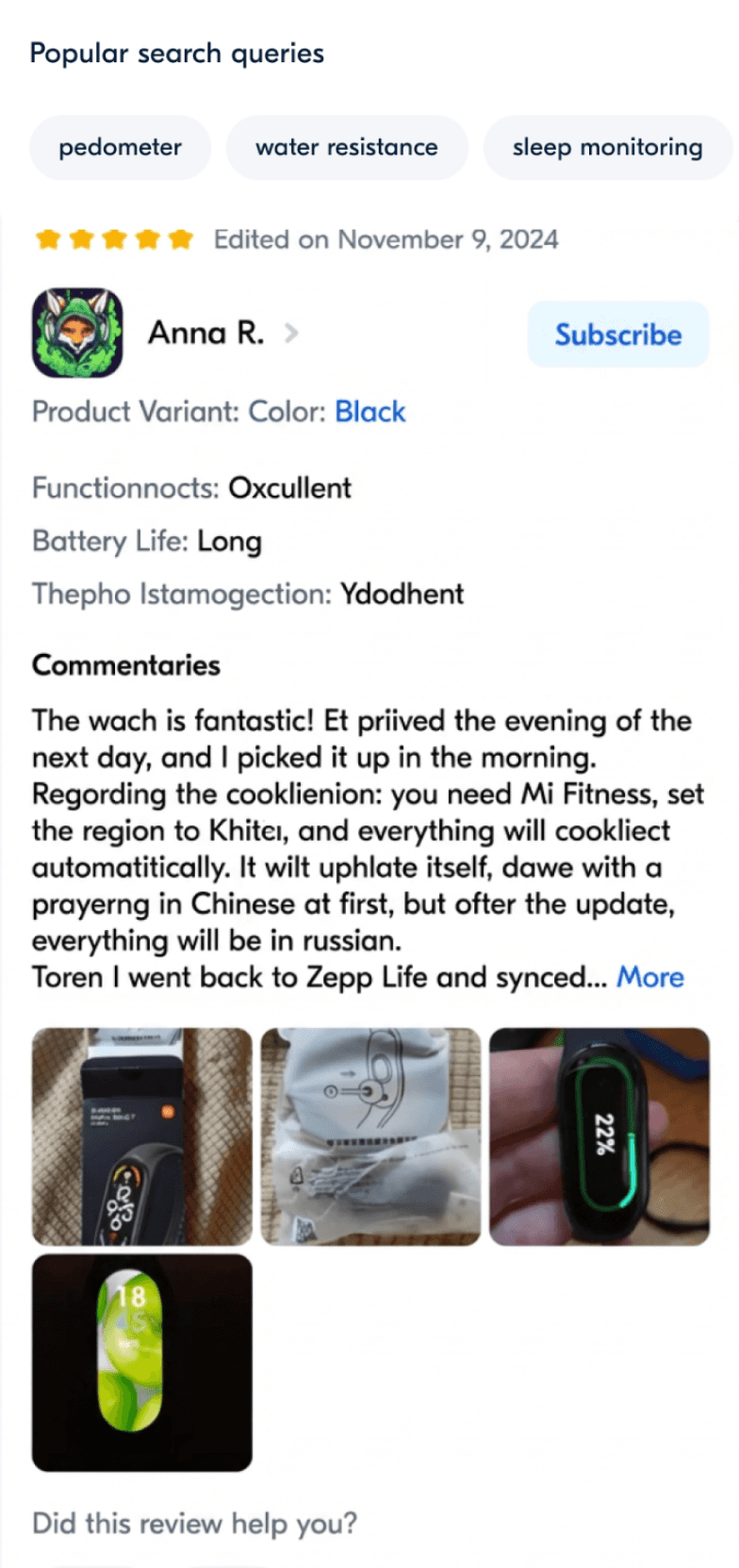
added quick view of reviews inside of product page
added tab for reviews, when you scroll down, cause often users get lost because of huge volume of information
fixed on top important tabs to get to needed section faster
first of all you see usefull reviews, which means more liked and fresh (in current version it looks more random)
«popular search» tags added, so that the user could select quick filter to get needed info faster
keyword search helps users to find specific info in reviews
Hypohesis 3 and 5. Additional options for payment through QR and adding items after payment
added button to save QR and use it in application, as some users had problems with opening bank app for non-primary banks
if the user forgot to buy some items (according to interviews it happens very often) it is possible to do it after payment
user can see top-fixed countdown for 10 minutes to add item for just payed order
Solution
Screens of the new user flow


Backlog
Future improvements
Adding products to the order
Optimizing steps and screens after clicking on payment: adding products in 1 click
Interface decluttering
Simplifying and minimizing visual noise for
new users and 45+ audiences.
Choosing product variations
Convenient selection of color and quantity
when adding to the cart without
unnecessary transitions.
Ozon · Mobile · E-commerce
Ideal flow of purchases
Ozon is one of the largest marketplaces in Russia.
You can buy almost anything there, even a car. The task was to create a purchasing path with the fewest steps, not only through the Ozon Card, but overall: how to reduce flow across various purchasing scenarios.
7
Hypotheses
6
Work stages
4
Interviews conducted
Test
With users
Task
Minimum clicks to purchase
To create the "ideal flow" for making a purchase on Ozon with the least number of steps. The task was considered not only through payment with the Ozon Card but more broadly: how to optimize the customer's journey across different product categories
The key challenge is to find a balance between the speed of checkout and user awareness, without sacrificing business metrics (average order value, conversion rate, advertising revenue)
Problem
Difficulties before payment
01
Unnecessary steps in the purchasing process
Especially noticeable when paying by card and receiving discounts and bonuses: the user goes through too many intermediate screens
02
Inconvenient navigation interface
"Very inconvenient interface, too many unnecessary clicks. For example, to pay by card, you have to go through a lot of steps", — from user interviews
Process
From briefing to A/B testing
01
Research
Brief, brand study, competitive analysis, studying the current user journey on Ozon
02
Hypotheses + interviews
Idea generation, 4 hypotheses, user interviews for validation
03
Flow + prototype
User flow, based on data and revisions, 8 prototype screens, usability tests
04
Design + A/B
Final design, UI kit, specifications, A/B testing
Competitive analysis
3 marketplaces compared
I thoroughly researched the user flow of three competitors: Yandex.Market, Wildberries, and Temu. For each of them, I created a complete task flow, documented all screens from search to payment, and analyzed strengths and weaknesses
Wildberries
Fast purchase flow, but overloaded
product cards and complicated category
navigation.
Yandex.Market
Cleaner interface, but a long path to
payment. Interesting solutions in filtering.
Temu
Aggressive upselling, but an effective
recommendation system after payment
and quick one-click purchase.
The analysis helped formulate hypotheses at the intersection of the best practices of competitors and the specifics of Ozon
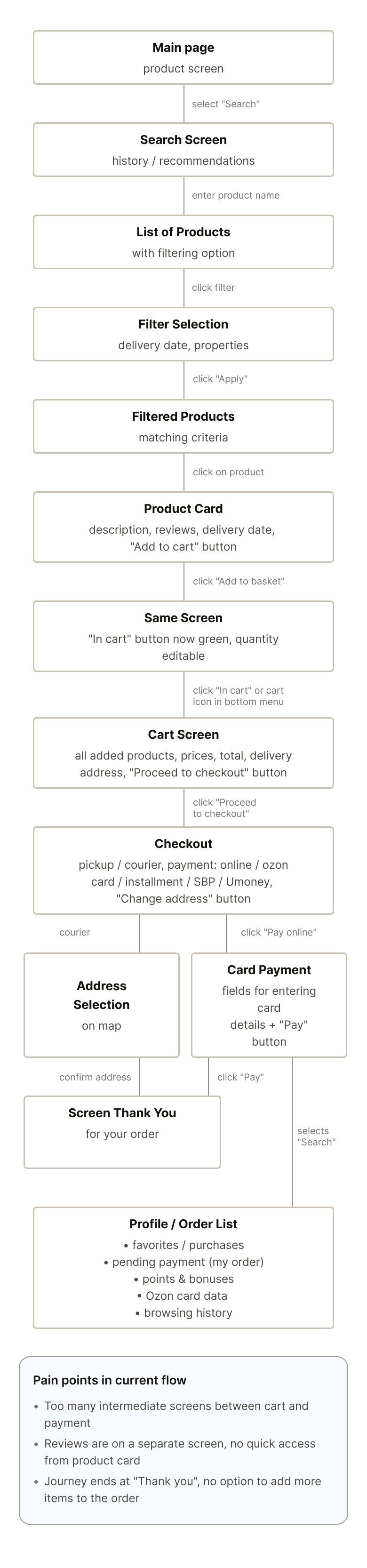
Current flow
How the purchase process works now
I documented the complete task flow in the Ozon app from the main screen to payment confirmation. I identified pain points: unnecessary steps between the cart and payment, lack of quick access to reviews, and a dead end on the "Thank you for your order" screen
Hypotheses
4 hypotheses tested through interviews
01
Adding items after checkout
Allowing users to add items to an already placed order could increase the average check by 10%
Need more data
02
Notifications about availability
Notifying about product availability at the cart stage will reduce abandonment during checkout by 20%. The hypothesis was not confirmed, because Ozon immediately offers a replacement
Failed
03
Quick review access
Reviews directly on the product card will speed up adding to the cart by 15%
Approved
04
Direct payment via SBP
A QR code without bank selection increases the number of successful transactions
Need more data
Insights from interviews
What users shared
Filtering reviews by keywords
Users want to quickly find relevant reviews instead of scrolling through everything
QR code as an alternative to card linking
Preferred by those users who value security and avoid linking cards
The Ozon card is more of a savings tool
Rather than a full-fledged banking product, perceived at the level of discounts and cashback
Order to the wrong address
A common problem that leads to order cancellation and reordering
To be continued...
Mobile version is in process, you can find whole case on desktop
Additional hypotheses
Hypotheses from insights
Based on insights from interviews, I added 3 additional hypotheses for further testing
Hypothesis 3
Quick scrolling of top reviews directly on the product card, as well as filtering by keywords and "helpfulness"
Hypothesis 3
Direct payment via SBP with QR code, without an intermediate bank selection screen
Hypothesis 3
Adding products after payment —> "Pay in 1 click" screen within 10 minutes + personalized recommendations
New flow
New f low based on data
Based on interviews and research, I created a user journey. 3 hypotheses were added to this flow for further testing. 8 screens prepared for minimal testing and hypothesis validation with real users
Backlog
Future improvements
Adding products to the order
Optimizing steps and screens after clicking on payment: adding products in 1 click
Interface decluttering
Simplifying and minimizing visual noise for new users and older audiences
Choosing product variations
Convenient selection of color and quantity when adding to the cart without unnecessary transitions
Hypohesis 1. I adopted the process according to how users work with reviews:
added tab for reviews, when you scroll down, cause often users get lost because of information
first of all you see usefull reviews, which means more liked and fresh (now it looks more random)
«popular search» tags added, so that the user could select quick filter to get needed info faster
keyword search helps users to find specific info in reviews
Solution
Screens of the new user flow
To be continued...
Mobile version is in process, you can find whole case on desktop
Portfolio. Adel
EN
DE
CV ↓