Healthtech · B2B · Desktop & Mobile
Insurance
platform
Insurance
platform
Company name and branding are changed to comply with NDA.
All personal data shown is fictional.
A product ecosystem for corporate health insurance: an AI-powered plan selector (accessible via a floating widget on the main site), a multi-page aggregator evolved from a landing page through 12+ iterations, and a back-office platform built on Ant Design for managing contracts, employees, and claims. The platform is live and serving real users.
3
Products designed
12
Pages of main site
12+
Landing iterations
Live
In production
Company name and branding are changed to comply with NDA. All personal data shown is fictional.
3
Products designed
12
Pages of main site
12+
Landing iterations
Live
In production
Product 1 · AI Assistant
Product 1 · AI Assistant
Smart insurance selector for HRs
Smart insurance selector for HRs
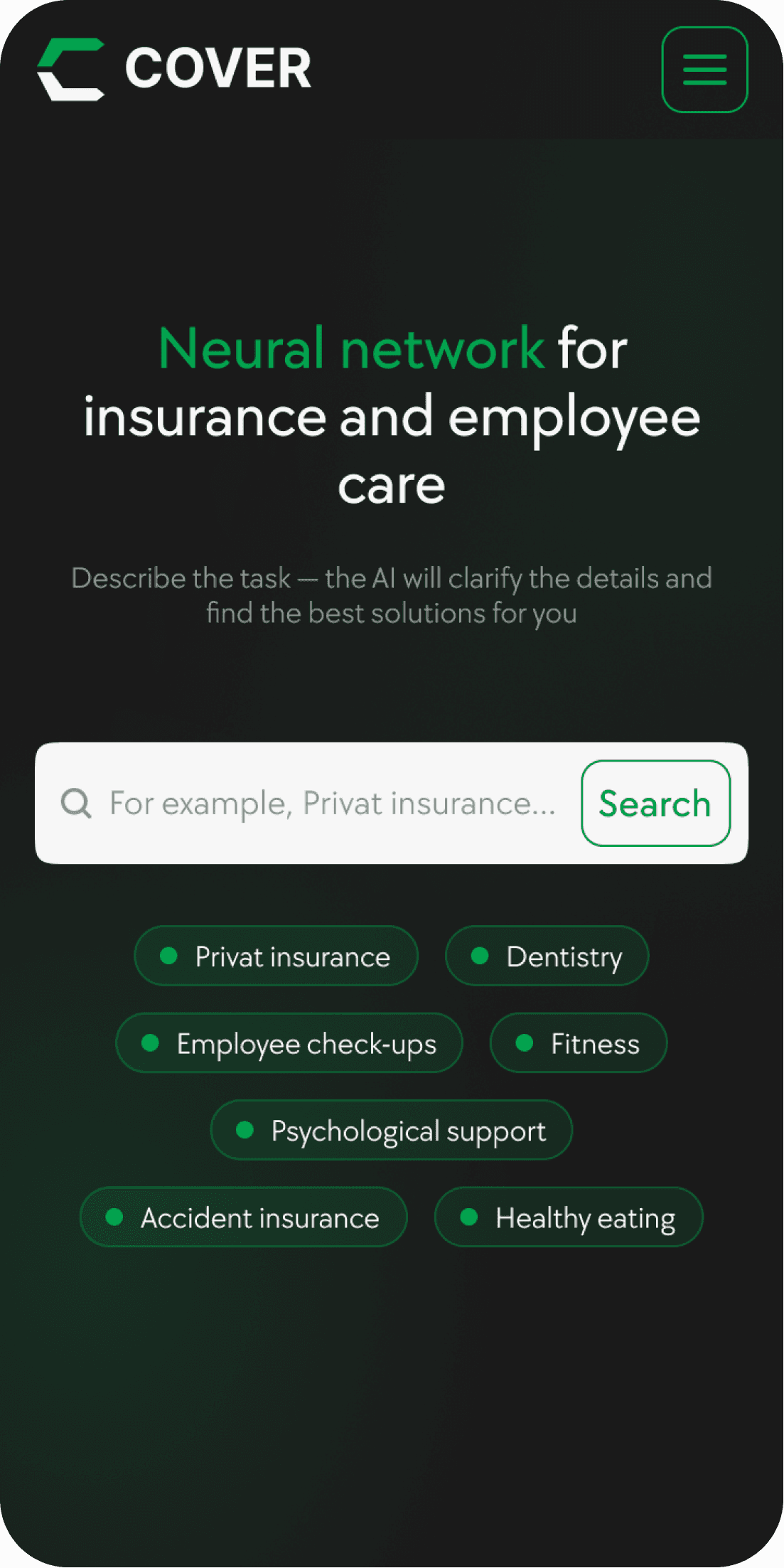
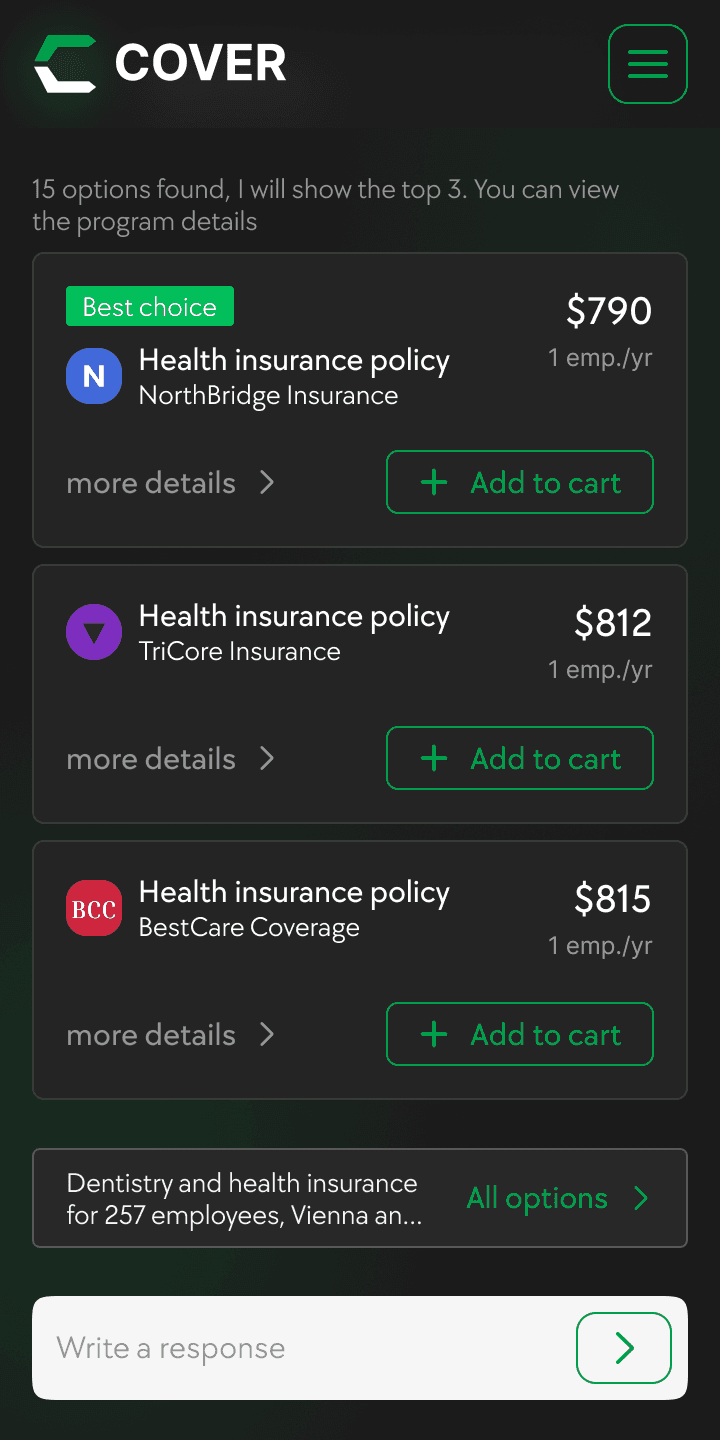
An AI-powered chat interface that helps HR managers find the right insurance plan. It lives as a floating widget on the main platform — a small button that expands into a full-screen assistant after 3 seconds. The user describes what they need in plain language, the assistant asks clarifying questions (coverage type, city, team size), and returns a ranked list of matching plans with pricing and coverage details.
An AI-powered chat interface that helps HR managers find the right insurance plan. It lives as a floating widget on the main platform — a small button that expands into a full-screen assistant after 3 seconds. The user describes what they need in plain language, the assistant asks clarifying questions (coverage type, city, team size), and returns a ranked list of matching plans with pricing and coverage details.
I designed the complete flow: search landing with category chips, conversational chat with quick-reply options, results with ranked plan cards, detailed plan view with coverage breakdown and clinic list, and a support page. Both desktop and mobile versions.
I designed the complete flow: search landing with category chips, conversational chat with quick-reply options, results with ranked plan cards, detailed plan view with coverage breakdown and clinic list, and a support page. Both desktop and mobile versions.
Mobile version

Product 2 · Aggregator
Product 2 · Aggregator
From landing page to multi-page aggregator
From landing page to multi-page aggregator
I get this project from a freelance designer who had built the initial landing page: a long single-scroll with a basic component kit (inconsistent naming, incomplete states). The page mixed a calculator, value propositions, FAQ, and CTAs without hierarchy and users dropped off before finding results.
Alongside working on the main platform, I gradually improved the landing based on tasks from PO, commenting on issues, proposing better patterns, building out a proper style library. I assembled the result cards, and from there it evolved into a full aggregator. PO and managers ran their own hypotheses and we go through 12+ iterations (and that's not all of them). At one point the CEO wanted to "redesign everything again", so I created a directional sketch exploring a multi-page approach with structured content blocks.
Alongside working on the main platform, I gradually improved the landing based on tasks from PO, commenting on issues, proposing better patterns, building out a proper style library. I assembled the result cards, and from there it evolved into a full aggregator. PO and managers ran their own hypotheses and we go through 12+ iterations (and that's not all of them). At one point the CEO wanted to "redesign everything again", so I created a directional sketch exploring a multi-page approach with structured content blocks.
All aggregator components were built from scratch: cards, comparison tables, filters, modals, pricing tiers, using references and selecting the best solution for each requirement. I build UI library to speed up design process.
All aggregator components were built from scratch: cards, comparison tables, filters, modals, pricing tiers, using references and selecting the best solution for each requirement. I build UI library to speed up design process.
Evolution: from freelancer's landing to aggregator
Adding Screens is in process
Landing before and agregator after
to be continued….
Healthtech · B2B · Desktop & Mobile
Insurance
platform
A product ecosystem for corporate health insurance: an AI-powered plan selector (accessible via a floating widget on the main site), a multi-page aggregator evolved from a landing page through 12+ iterations, and a back-office platform built on Ant Design for managing contracts, employees, and claims. The platform is live and serving real users.
3
Products designed
12
Pages of main site
12+
Landing iterations
Live
In production
Company name and branding are changed to comply with NDA.
All personal data shown is fictional.

Product 1 · AI Assistant
Smart insurance selector for HRs
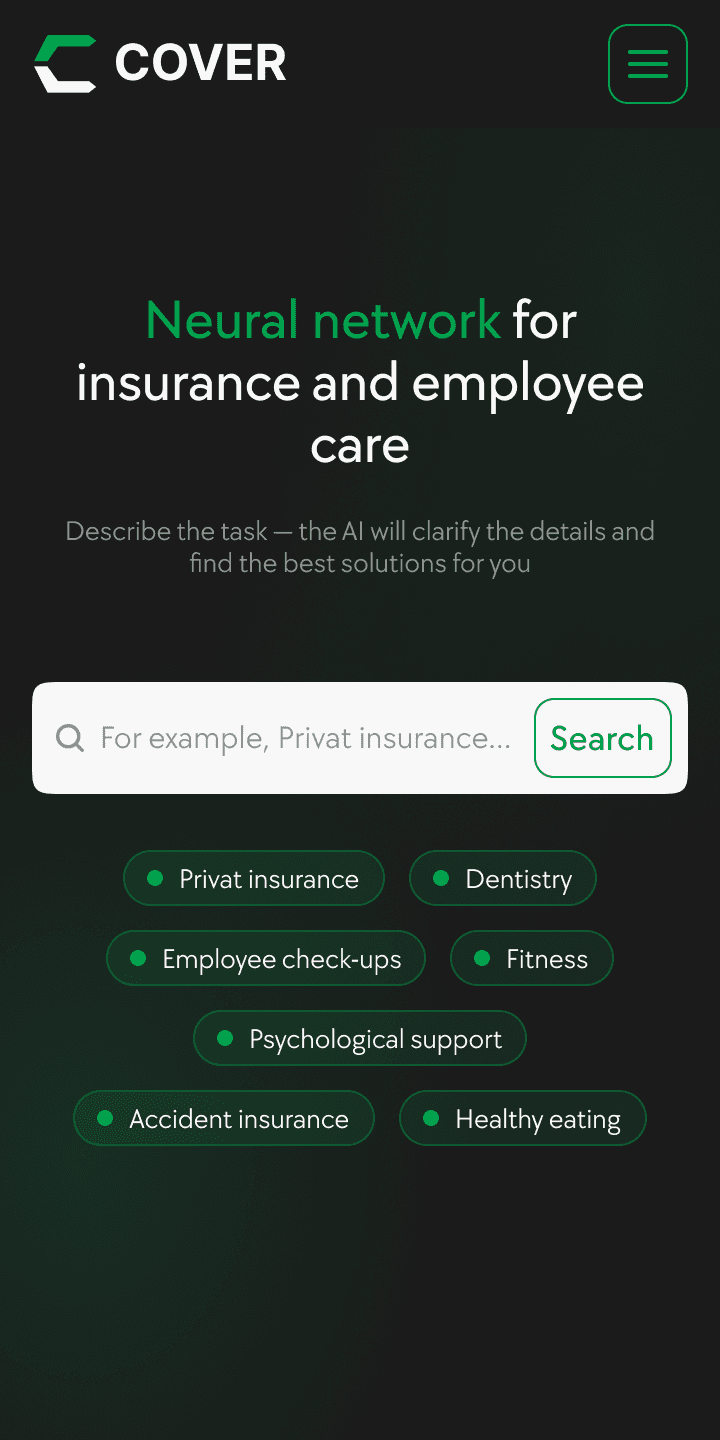
An AI-powered chat interface that helps HR managers find the right insurance plan. It lives as a floating widget on the main platform — a small button that expands into a full-screen assistant after 3 seconds. The user describes what they need in plain language, the assistant asks clarifying questions (coverage type, city, team size), and returns a ranked list of matching plans with pricing and coverage details.
I designed the complete flow: search landing with category chips, conversational chat with quick-reply options, results with ranked plan cards, detailed plan view with coverage breakdown and clinic list, and a support page. Both desktop and mobile versions.
Product 2 · Aggregator
From landing page to multi-page aggregator
I inherited this project from a freelance designer who had built the initial landing page: a long single-scroll with a basic component kit (inconsistent naming, incomplete states).
The page mixed a calculator, value propositions, FAQ, and CTAs without hierarchy and users dropped off before finding results.
Alongside working on the main platform, I gradually improved the landing based on tasks from PO, commenting on issues, proposing better patterns, building out a proper style library. I assembled the result cards, and from there it evolved into a full aggregator. PO and managers ran their own hypotheses and we go through 12+ iterations (and that's not all of them). At one point the CEO wanted to "redesign everything again", so I created a directional sketch exploring a multi-page approach with structured content blocks.
All aggregator components were built from scratch: cards, comparison tables, filters, modals, pricing tiers, using references and selecting the best solution for each requirement. I build UI library to speed up design process.
Wildberries
Fast purchase flow, but overloaded
product cards and complicated category
navigation.
Yandex.Market
Cleaner interface, but a long path to
payment. Interesting solutions in filtering.
Temu
Aggressive upselling, but an effective
recommendation system after payment
and quick one-click purchase.
The analysis helped formulate hypotheses at the intersection of the best practices of competitors and the specifics of Ozon
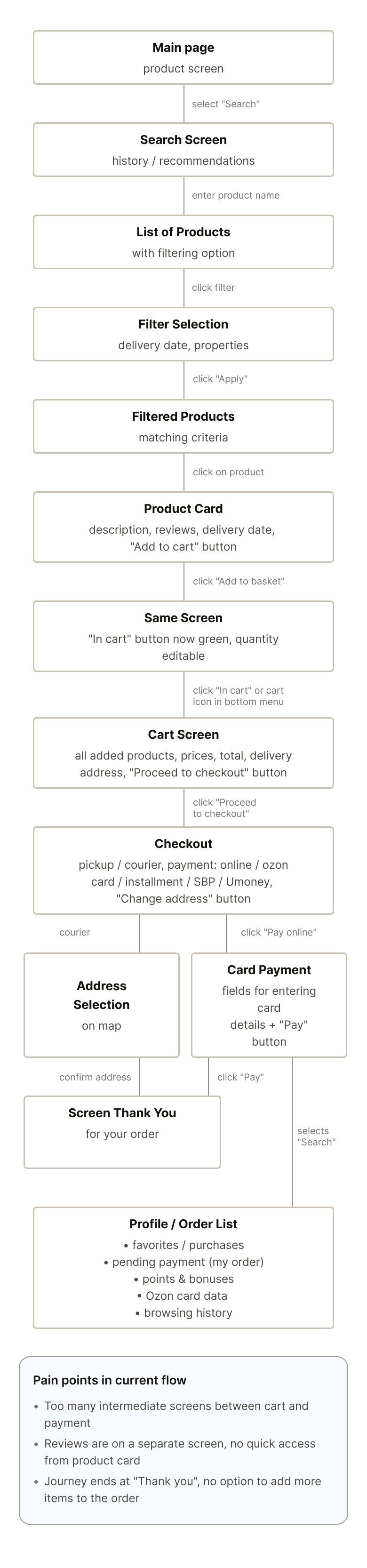
Current flow
How the purchase process works now
I documented the complete task flow in the Ozon app from the main screen to payment confirmation. I identified pain points: unnecessary steps between the cart and payment, lack of quick access to reviews, and a dead end on the "Thank you for your order" screen
Hypotheses
4 hypotheses tested through interviews
01
Adding items after checkout
Allowing users to add items to an already placed order could increase the average check by 10%
Need more data
02
Notifications about availability
Notifying about product availability at the cart stage will reduce abandonment during checkout by 20%. The hypothesis was not confirmed, because Ozon immediately offers a replacement
Failed
03
Quick review access
Reviews directly on the product card will speed up adding to the cart by 15%
Approved
04
Direct payment via SBP
A QR code without bank selection increases the number of successful transactions
Need more data
Insights from interviews
What users shared
Filtering reviews by keywords
Users want to quickly find relevant reviews instead of scrolling through everything
QR code as an alternative to card linking
Preferred by those users who value security and avoid linking cards
The Ozon card is more of a savings tool
Rather than a full-fledged banking product, perceived at the level of discounts and cashback
Order to the wrong address
A common problem that leads to order cancellation and reordering
Additional hypotheses
Hypotheses from insights
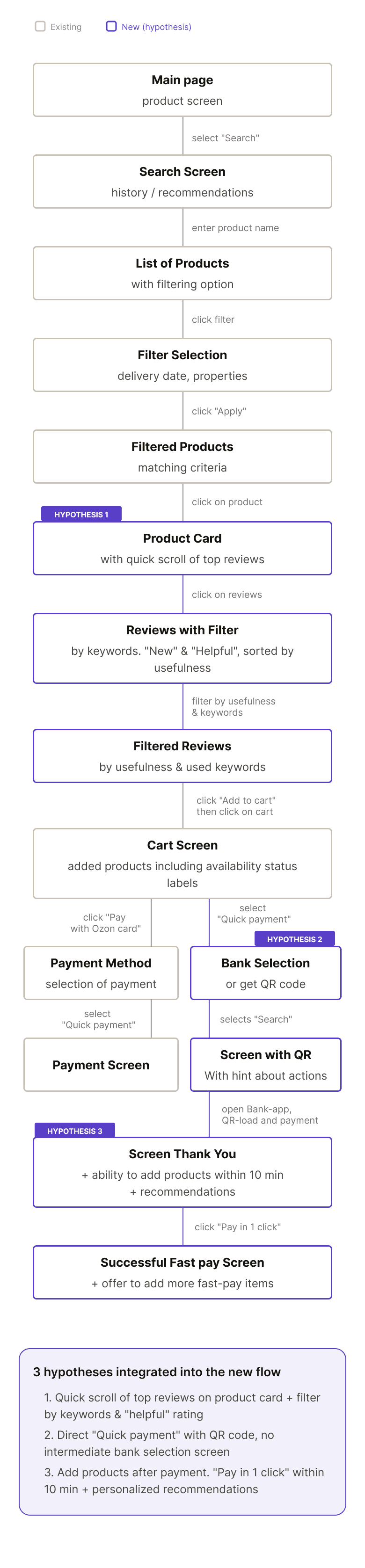
Based on insights from interviews, I added 3 additional hypotheses for further testing
Hypothesis 3
Quick scrolling of top reviews directly on the product card, as well as filtering by keywords and "helpfulness"
Hypothesis 3
Direct payment via SBP with QR code, without an intermediate bank selection screen
Hypothesis 3
Adding products after payment —> "Pay in 1 click" screen within 10 minutes + personalized recommendations
New flow
New f low based on data
Based on interviews and research, I created a user journey. 3 hypotheses were added to this flow for further testing. 8 screens prepared for minimal testing and hypothesis validation with real users
Backlog
Future improvements
Adding products to the order
Optimizing steps and screens after clicking on payment: adding products in 1 click
Interface decluttering
Simplifying and minimizing visual noise for new users and older audiences
Choosing product variations
Convenient selection of color and quantity when adding to the cart without unnecessary transitions
Hypohesis 1. I adopted the process according to how users work with reviews:
added tab for reviews, when you scroll down, cause often users get lost because of information
first of all you see usefull reviews, which means more liked and fresh (now it looks more random)
«popular search» tags added, so that the user could select quick filter to get needed info faster
keyword search helps users to find specific info in reviews
Solution
Screens of the new user flow
To be continued...
Mobile version is in process, you can find whole case on desktop
to be continued….